Read capacity.
Run your policy.
Keep the record.
Creditworthiness assessment infrastructure for lenders. Neumetria reads a person’s current capacity from lived activity, runs the credit policy you published under the oversight you chose, and keeps the evidence needed to reconstruct the assessment later.
One assessment,
three parts.
A lender buys one assessment object. It joins the person’s current capacity to the exact policy version that ran, the oversight path that applied, and the evidence available at that moment.
Income rhythm, committed outflows, liabilities and resilience, read from lived activity for this person now. Affordability travels with the read as context.
Your conditions, thresholds and outcome words, validated and versioned before publication. Neumetria executes them exactly as written. You choose the oversight.
The facts, model version, policy version, reasons and resolution path are frozen together. A later reader can reconstruct the assessment without depending on today’s data or code.

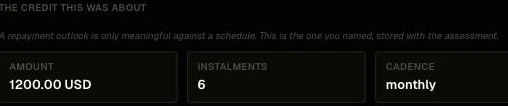
Current capacity,
with evidence attached.
One call returns the person’s current readiness and the evidence beneath it. Each part carries confidence, an as-of date, observation counts and the activity it came from.
Stability, composition and timing of inflows. Payroll, benefits and irregular streams remain distinct, with the evidence window visible.
Recurring outflows and essential load. The read shows what remains after ordinary commitments, not after a best-case month.
Observed debt service and stacked short-term obligations. This is current cash-flow context beside bureau history, not a substitute for it.
Buffer, recovery and signs of strain, including exposure to event contracts and chasing after a loss, read from the sequence of stakes and settlements rather than a gambling total. The question is how this person absorbs disruption now, with uncertainty left visible.
The stack already supplies
- — Credit history and bureau attributes
- — Transaction access and provider-normalised activity
- — Declared income, expenses and requested terms
- — Your credit policy and outcome vocabulary
- — Your governance and review process
The assessment layer adds
- + Lived activity interpreted as current capacity
- + A readiness of the person, beside the bureau
- + Confidence, as-of dates and named gaps
- + Your published policy executed against the read
- + One reconstructable record of the run


The answer carries
its proof.
Evidence is part of the response, not a dashboard assembled later. What was observed, how much of it existed, when it was current, what could not be read and which version interpreted it all travel with the assessment.
Every object carries confidence, as-of and the activity behind it, including observation counts. Six observations and six hundred never look equally supported.
Missing or stale inputs return insufficient data and name what is absent. The system does not turn a thin history into a confident middle value.
The read is linear in its factors, so a reason is an exact share of the result rather than a story told afterwards. Reasons are generated from the mechanism that ran, then stored at the time of the run.
Recorded reads hold the values themselves, not pointers to whatever the system would say today. Weights and thresholds are part of the contract too, so neither moves without a new version. Later, you can show what was served, when, on data through what date and under which version, never against a specification that has since drifted.


You write the rules.
The engine follows them.
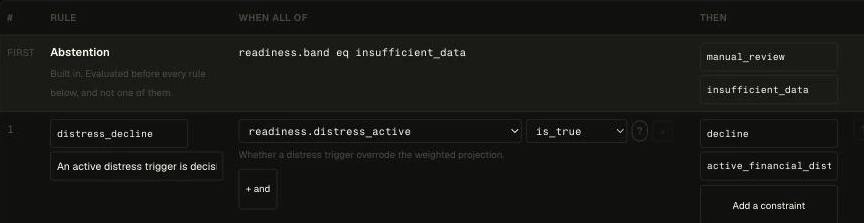
Your policy contains your conditions, thresholds and outcome words. You author it. Neumetria validates it, replays it over recorded assessments, and executes the published version against the capacity read. The rule table and the outcome remain yours.
You author every rule. Your outcome words pass through verbatim.
Run a candidate over your own recorded assessments before publishing it. The replay uses the production evaluator and stored inputs, so the comparison is exact for that history.
Unknown facts, illegal operators, out-of-range values, undeclared outcomes, unsatisfiable rules and shadowed rules block publication. The analysis report stays with the version.
Choose review for every run, automated execution, or automated execution with a sample routed to reviewers. For automated policies, record the basis you rely on before publication: the statutory ground where your regime names one, and your own reasons in every case.
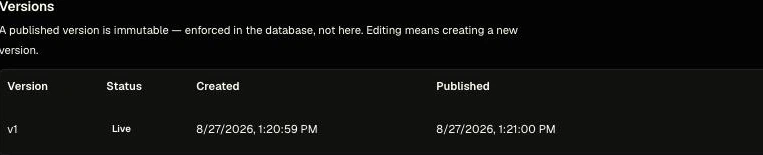
Each run freezes the facts it saw, both versions, the reason set, the oversight path and the customer outcome. A later change creates a new run rather than editing the old one.
Your policy declares the jurisdiction it answers to, and the version freezes it. The consumer explanation follows: the Reg B form under US, the CCD2 form under EU, a statute-neutral statement under MENA, in English or Arabic, and a rendering outside your regime is refused rather than served. A Shariah overlay requires your board’s recorded approval and refuses at publish the facts conventional bank data cannot support. Nothing in it is a certification by us.
A right that cannot change the record
is not a right.
A route to a person, a meaningful explanation, the ability to contest, and reassessment to complete the path. The machinery for all four ships built in and stays on in every oversight mode. In the EU, these are the rights CCD2 Art. 18(8) gives consumers after an automated creditworthiness assessment.
Blocking review, automated execution or sampled review: the route to a person remains available. It is not a policy setting and cannot be disabled.
One stored reason set supports every rendering: the creditor’s adverse-action notice, a data-subject access response, and the consumer credit view, which ranks adverse factors first and keeps missing evidence separate from factors that counted against the person. Which form is served follows the regime your policy declared, and one outside it is refused.
A contest can name only factors from the reason set the person saw. Unknown factors are refused, not accepted into an inbox where they cannot affect the assessment.
A correction creates a new assessment and policy run linked to the original. The old record stays frozen, so a later reader sees both runs and why the second exists.

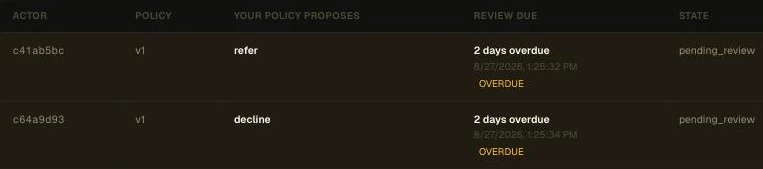
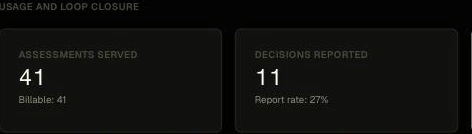
The record starts at assessment.
It learns only when you close it.
Close the loop with the outcome your institution chose and how the obligation performed. The assessment, choice and performance stay connected in one reconstructable history.

The model file
stays tied to the system.
Model cards and the risk register are generated from the live configuration, so the file your validator reads stays tied to the system that ran.
An SR 11-7-shaped card and an EU AI Act Annex IV technical file are generated from the live configuration, never written by hand. Change a parameter and the file changes with it.
Each risk names an owner, a status and the control that answers it. The generated file keeps those links current as the system changes.
Each inference records the inputs and versions used, with a digest and purpose-specific retention. Daily seals make later alteration visible. A legal hold suspends expiry.


Your rules, your oversight,
your outcome.
We execute your policy. We never decide.
Neumetria reads capacity from available activity and executes the policy version you published, under the oversight you chose.
Blocking, automated or sampled: the mode is yours and the record says which path ran. Art. 18(8) intervention, explanation and contest remain available in every mode.
Teams that need a fast capacity read, their own policy executed, and a reconstructable record for each assessment.
Teams that need current cash-flow context beside the bureau, with the same evidence available at origination and servicing review.
Teams embedding credit inside another journey without giving a third party ownership of policy, oversight or outcome.

Make the assessment reconstructable.
If your credit stack already has access and policy, add the capacity read, rights machinery and record between them.