Agents propose.
Your policy decides.
An agent proposes an action: this amount, this merchant, now. Neumetria assesses the person for that specific act, executes the policy you published against the assessment, and answers inside the turn. The outcome words, the ceilings and the reason codes are yours.
A band reads the person.
An action is specific.
Readiness describes the person: whether this is a moment for spending, saving, investing, or none of them. It does not answer whether an agent may spend €1,200 at this merchant right now. That question needs the action itself, and a rule you wrote about it.
An agent acting on someone’s behalf asks what a lender asks about a loan: does this person’s position support it. The difference is the clock. A lender has days. An agent has the rest of the turn.
So the assessment and the policy run together, against a fact snapshot written before the answer returns. Nothing is recomputed later against signals that have since moved, which is what makes the run readable a year afterwards.
Two calls,
inside the turn.
Assess the person for the action. Execute your policy against that assessment. Nothing is queued and nothing is polled.
The everyday agent action, assessed against the discretionary capacity the person has today. Send whatever merchant name the agent holds; resolving it to the entity we know is our job, not yours.
A credit action carries its instalments and cadence, so a borrowing question reaches the same surface, the same rule engine and the same record as the purchase beside it.
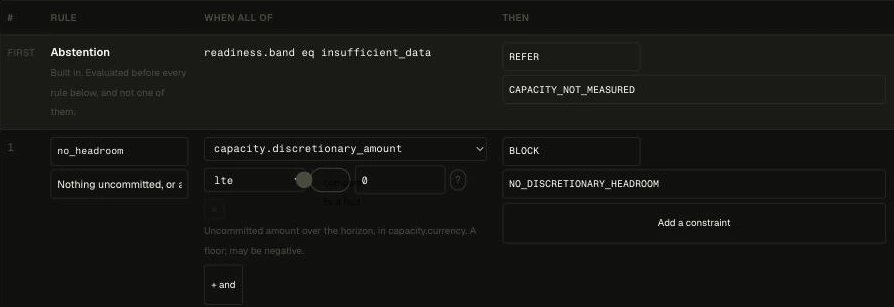
Every word in that response is yours. ALLOW_WITH_LIMITS is an outcome you declared, RENT_DUE_4_DAYS a reason you named, and the ceiling is the value of a rule you wrote, resolving against a measurement we served.
// illustrative evaluation response
{
  "outcome": "ALLOW_WITH_LIMITS",
  "reasons": ["RENT_DUE_4_DAYS"],
  "constraints": { "max_amount": 640.25 },
  "matched": {
    "kind": "rule",
    "rule_id": "near_large_obligation"
  },
  "policy": { "key": "agent_spend", "version": 4 }
}
Automated,
and said so.
An answer inside the turn has nobody to wait for. Action policies publish in automated mode only: a blocking review is refused at publish rather than recorded as one that never happened.
You record the Article 22(2) basis on the version and it is frozen there. A share of runs that you set reaches a person after the fact, so your override rate stays measurable on the highest-volume surface you run.
A post-hoc review records agreement, or disagreement, with an outcome the caller already acted on. It is never presented as a review that prevented one.
We execute your policy.
We never decide.
The outcome words are yours.
Neumetria has no vocabulary of allow or block. We supply the measurement and run the rule you wrote against it; every string that comes back is one you authored.
The caller is your agent, never the consumer’s. Serving a spending ceiling to a person’s own shopping assistant would be advising a consumer about their money, and that is the boundary this company does not cross.
Nothing here carries a calibrated reading, and no purchase produces an outcome label to learn from. Where learning happens, it happens on credit.
Teams whose agents act on money and want a rule that runs before they do, not a paragraph in a system prompt.
Teams putting an assistant in front of real accounts, with a published limit behind it and a record of every time it applied.
Teams already running a credit policy here, extending the same engine to the checkout an agent drives.

