 by Amr Mohamed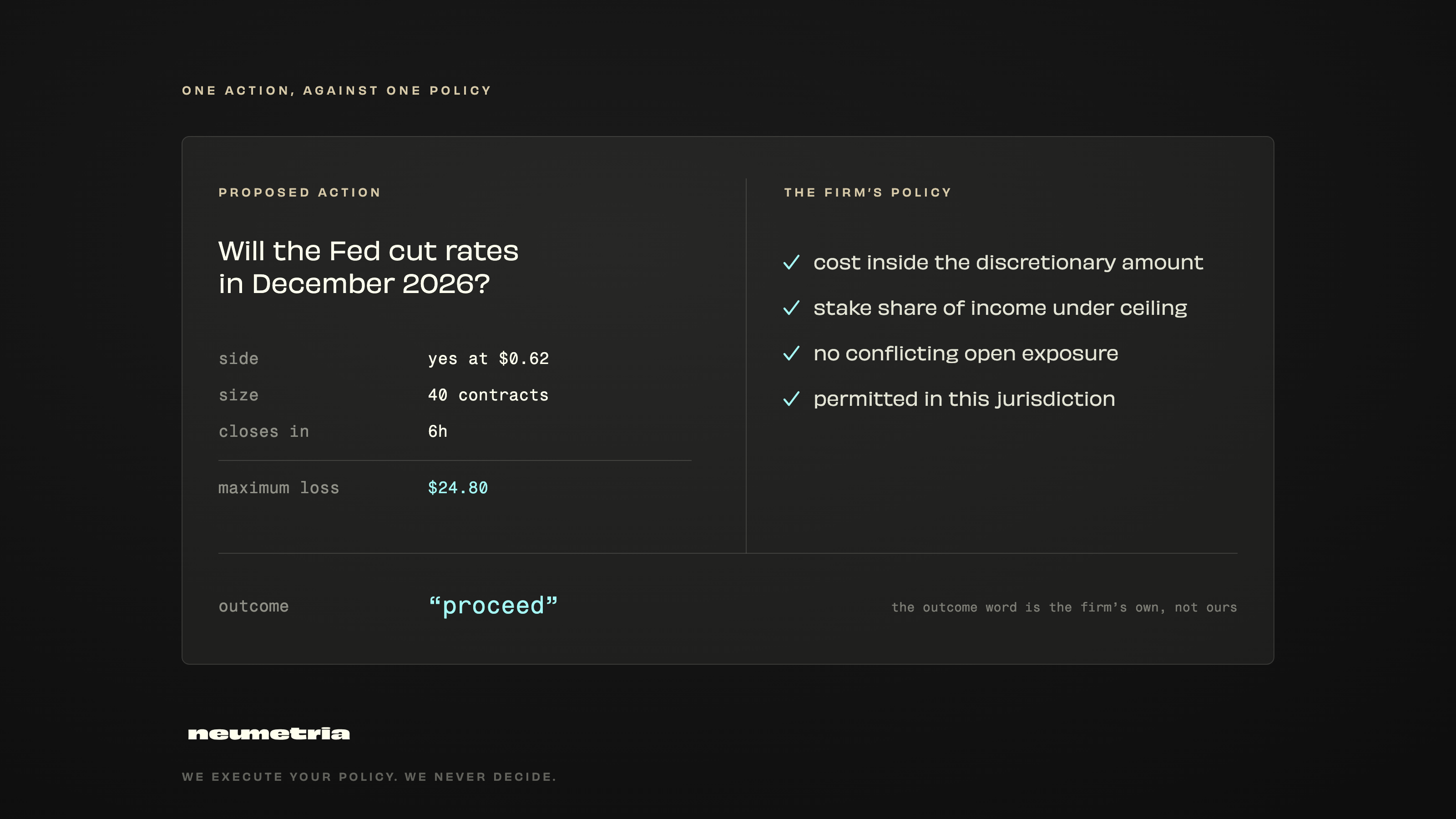
An agent holds an API key, a person's account, and six hours until a contract closes. It can read the book, size a position, and fill. None of that is a forecast about where the market is going. It is available today, over HTTP, on venues anyone can sign up to.
Why this market, and not another one
Every asset class is getting agent tooling. Event contracts are the first one where the agent does not need a workaround.
The instrument is binary, so there is one number to size against. It carries a resolution date, so a position closes itself whether or not anyone is watching. Notional is small, which is why a person tolerates an agent acting without asking first. And both venues expose fills, positions and settlements as ordinary API objects: Kalshi as a market with a status lifecycle from open to settled, Polymarket as paired outcome tokens with a dollar of collateral behind each pair. A machine can hold the whole position lifecycle without a human reading a statement.
Compare that to equities, where the agent needs a broker relationship, a suitability regime built for a human intermediary, and a position that never ends. Event contracts remove most of that mechanical friction, which is why agents arrive here first. The legal regime does not go anywhere, as the rest of this piece argues. The mechanics just stop fighting the machine.
The failure mode is the second position
Because the market rewards being right, almost everyone building here is competing on being right. Better retrieval, better priors, better calibration against the resolution source.
Forecast quality is not what goes wrong.
A contract resolves against someone at 11pm. Within the hour there is another position, at a larger size, on something closing sooner. Both fills are valid. Both were affordable on their own. The venue has no reason to treat either as an event. The sequence is the thing that matters, and the sequence is not visible from inside the order flow.
The same pattern has a second shape: positions that cluster into the last hours before settlement, when the price moves fastest and there is no time left to be early. And a third: stake size ratcheting upward over weeks while income stays flat.
None of this is a statement about a person's character. It is a pattern in timing and size, and it either shows up in the record or it does not.
Two blind spots, one sequence
The reason it usually does not show up is that the sequence is split across two systems, and neither one holds both halves.
The venue sees the book and not the paycheck. It knows the position, the price and the settlement. It has no view of what arrived in the person's account this month, or whether it arrived on time.
The bank sees the funding movement and not the position. A transfer to an event-contract venue arrives as a card or ACH debit with no merchant pattern behind it, so it lands in general spend. Where a categoriser does resolve it, it resolves to gambling, which yields a spend total and a payout total and stops there. A total is not a sequence. The position that resolved, and what happened to the person's cash afterwards, are in neither picture.
A fixed payout makes the limit writable
Here is the part that makes this asset class more tractable than it looks, not less.
The payout of an event contract is fixed. One contract pays a known amount at settlement or it pays nothing. So on a fully funded long position, with no leverage and nothing borrowed, the maximum loss is the cost of the position. Not an estimate, not a distribution with a tail: the cost, exactly, known before the fill.
That splits the question an agent is carrying into two, and they are not the same question.
Forecasting asks whether this contract will pay.
Governance asks whether this agent may put this person's $500 at risk right now.
The first needs a probabilistic model. The second needs three things that are all knowable: the exposure, the person's current financial position, and the firm's own policy. In a margin account the second question needs a model too, and a model cannot really be disclosed to the person it is applied to. Here the limit can be a rule: written by the firm whose agent is acting, stated in their own words, attached to the action it refused, and reconstructable a year later when somebody asks why.
That is a governance property, and it belongs to the instrument rather than to any vendor.
What the contract is about decides what it is
The rule has to know what the contract is about before it knows what it is looking at.
In the United States an event contract at Kalshi is a CFTC-regulated derivative. In the EU, ESMA's public statement of 3 July 2026 makes the underlying event the classifying question: only where that underlying sits in Annex I, Section C(4) to (10) of MiFID II is the contract a financial instrument, and where it is, it is a derivative caught by the national product intervention measures on binary options, retail distribution prohibited. Where it is not, it may still be a bet under national gambling law. The UK divides the same way. The FCA's 2026 perimeter report places contracts on sport and politics under gambling legislation, and contracts referencing financial or certain climatic events inside the financial perimeter, where they are binary options and the 2019 retail ban applies. In several markets the instrument is impermissible outright, as maysir.
Read that again with an agent in mind. The payoff shape does not change. The API call does not change. What changes is the subject of the question, and the subject of the question selects the regulator. An agent picking tomorrow's contract is picking a regulatory regime, and nothing in its prompt tells it so.
That is not a judgment for the agent, or for whoever wrote its prompt. It has to arrive as configuration, from the firm carrying the licence, and it has to change the outcome rather than the small print.
And whatever the rule says, it has to answer inside the turn. An agent deciding on a contract that closes this afternoon cannot queue for a review that happens tomorrow. A guardrail here is machine-readable or it is decorative.
The question forecast quality cannot answer
An agent can be perfectly calibrated and still place a position the firm governing it would never have allowed. Forecast quality does not answer that, and better forecasting never will. It is a different question, running alongside.
Is this a good position? That one belongs to the agent.
Is this an acceptable position for this person, under the policy governing this agent, right now? That one belongs somewhere else.
This is the layer we work on. Neumetria gives an agent a current read of the financial state of the person behind the action, then evaluates the policy you published against the action your agent proposes, inside the turn and in your own vocabulary. You define the policy. Your agent proposes the action. We execute your policy. We never decide.
So the question for anyone shipping a financial agent is not only how good its forecast is. It is narrower and harder to answer: what does your agent know about the person whose money it is about to put at risk, and who wrote the limit it obeys?